Delving into Irish history can be a depressing endeavour. Oliver Cromwell and his genocide; the Penal Laws; the Great Potato Famine of 1845 to 1851; are just tasters of the misery of the nation over the past five hundred years . Last night I stumbled upon another horror which had hitherto been unknown to me – the Year of the Slaughter between 1740-1741.
I had been aware that the the Great Hunger of 1845 – 1851 is regarded as a defining event in the creation of modern Ireland when one million people died from starvation and disease, and one million emigrated to the USA and Canada when the potato crop failed. The population of Ireland was eight million before the Famine and to this day is still below that level. In school in Ireland we learn about this tragedy and we know that Ireland remained a net exporter of food throughout this horror thanks to the English government’s murderous greed, cruelty and xenophobia. One eighth of the population died. One eighth of the population emigrated (and this emigrant population in North America became very important in securing Ireland’s partial independence in 1922).
Last night I discovered that one century earlier between 1740 and 1741 there was another Famine in Ireland that killed a greater percentage of the population.
Despite my near miss when I accidentally boarded the Tirana to Rome, rather than the correct Tirana to Bergamo flight, we landed in Bergamo on time at 10am. My flight back to Ireland was not until 9pm the following evening. My trip had been extended for a specific reason – I wanted to finally visit ‘The Last Supper’ by Leonardo DaVinci in Milan. This is a painting I have wanted to see since childhood. It’s not an easy undertaking, however. Located in a climate and temperature-controlled monastery, visitors are strictly limited in number. Tickets to see it are like gold dust. I had forked out fifty-four euros for a guided tour of the painting – justifying the price with the realisation that unless I was willing to pay this amount then I’d never likely see it.
I took a bus from Caravaggio Airport in Bergamo to the Central Rail station from there I walked to my hotel which took an hour. This was my first time in Italy’s second largest city.
Milan had never been high on my list of places I wished to visit. Italy is such a beautiful country there always seemed to be a more appealing option. This time was different.
Duomo di Milano
After dropping my bags at my hotel, I strolled over to the Duomo di Milano – the ridiculously ornate cathedral of Milan. It’s an architectural marvel on a par with the Sagrada Familia in Barcelona. To take the lift to the roof was more expensive than to take the stairs but it was my chosen option. Having walked an average of twenty kilometres per day while in Albania my leggies were exhausted. I must give props to the Catholic Church – they know how to do a glamourous church.
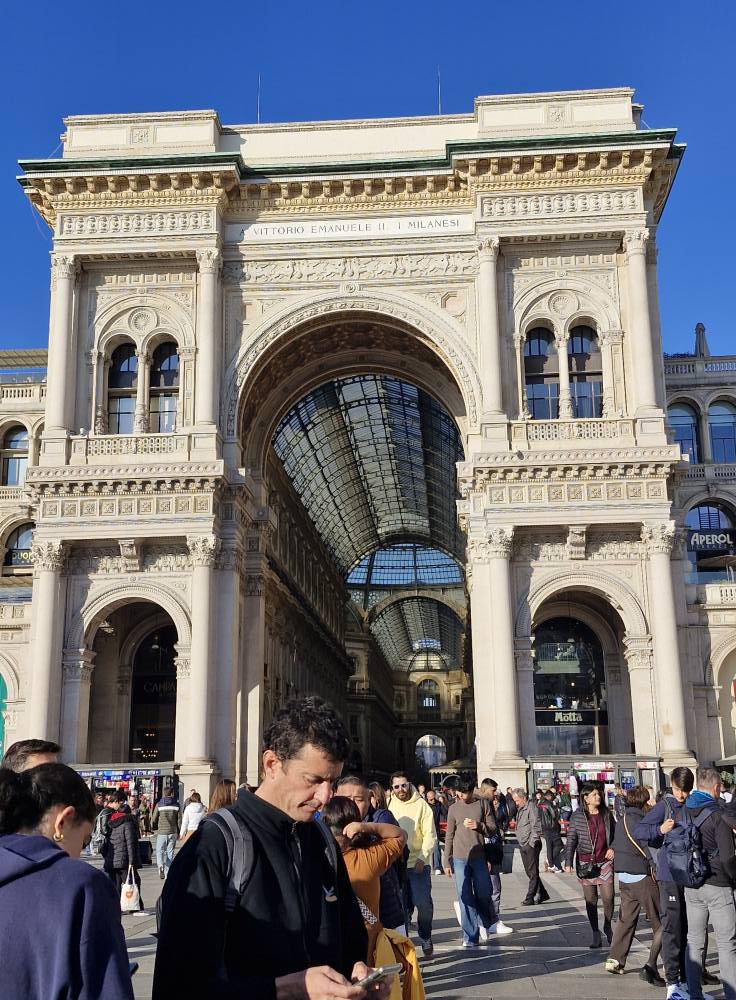
I spent an hour on the roof and inside the church before exiting on the Piazza Del Duomo and made my way to the Grand Galleria Vittorio Emanuele II on the square. This is an opulent nineteenth century shopping mall housing all the unaffordable Italian designer labels – Milan is a world centre of fashion on a par with Paris and New York. You can tell – the locals are impossibly thin, beautiful, and stylish. I didn’t buy anything. The prices were not visible on many items indicating that it would require a mortgage to buy them.
Grand Galleria Vittorio Emanuele II
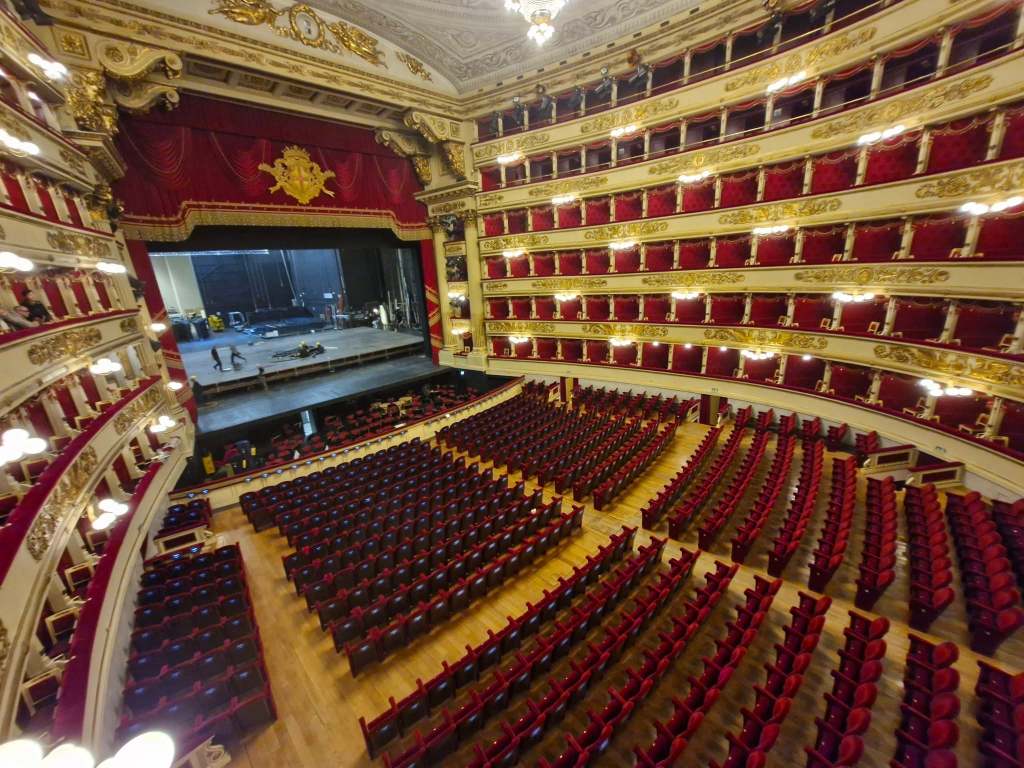
Making my way to La Scala opera house I noticed a queue coming out the door. There was a self-guided tour of the place. I waited in line behind an Italian woman who took about fifteen minutes to purchase her ticket. Why rush I guess. It’s an interesting building with an informative museum included. Not quite on a par with La Fenice in Venice, but in the vicinity.
La Scala Opera
The fifteenth century Castello Sforzesco is located a fifteen-minute walk away. Relieved to discover that its museum was closed on Monday I whiled away an hour wandering about its grounds, before heading back to my hotel.
My flight to Tirana in Albania was via Bergamo in Italy – or ‘Milan-Bergamo’ as Ryanair calls it – as if Bergamo is a mere suburb of Milan and not a separate city of 120,000 people, more than fifty kilometres away. Flying over the Alps into Bergamo gave impressive views – not a cloud in the sky with mountains, towns and lakes fully visible from the airplane forty thousand feet in the sky. It was Friday November 8th, 2024, and for the first time in my life I was visiting the Balkan nation of Albania. Landing at 11.10 in Bergamo I had a four-hour layover until 15.20. My friend G was waiting for me in Tirana – he had arrived from Heathrow a few hours before I landed.
Skanderberg Square, Tirana
The internet had warned me that public transport from the airport to the city centre was sporadic, so we had booked a transfer to our apartment with our landlord at a decent price. What a very friendly and talkative man. He gave us a running commentary about the buildings we saw on the way to the city centre. He told us that the route to the airport was like a continuous building site as Italian investors were swooping in to erect buildings now that the Albanian government has decided that Albania needs to become Mediterranean tourist hotspot.
Our apartment was located about fifty metres from the city’s main Skandenberg Square. We dined that evening at the restaurant Ceren Ismet Shehu in the grounds of the Toptani Castle just off the Square. This was a traditional Albanian restaurant with a wood fire burning in the middle. A very tasty and very meat heavy dining experience. The Toptani Castle has become a nightlife area so after our meal we enjoyed a few glamourous cocktails for about a quarter of the price you’d pay in Ireland (one hundred Albanian lek is worth about one euro).
Our plane touched down in Ibn Battouta Airport in Tangier at 9.50pm on Saturday night so we hopped into a taxi driven by a friendly man named Omar and asked him to call our host Mohamed. We were going to be staying on the narrow laneways of the walled old town (medina) of Tangier so he had to give Omar instruction where to drop us so he could take us to our lodgings. The medina is inaccessibly by car. Our house was an old-style house with a rooftop courtyard and blue tiles on the walls. It was already quite late when we arrived, so we headed over the coast (about ten minutes’ walk away) for an evening meal before heading to bed for an early night. There was walking to be done the following day and we wanted to be fresh.
Break from a busy day, Tangier
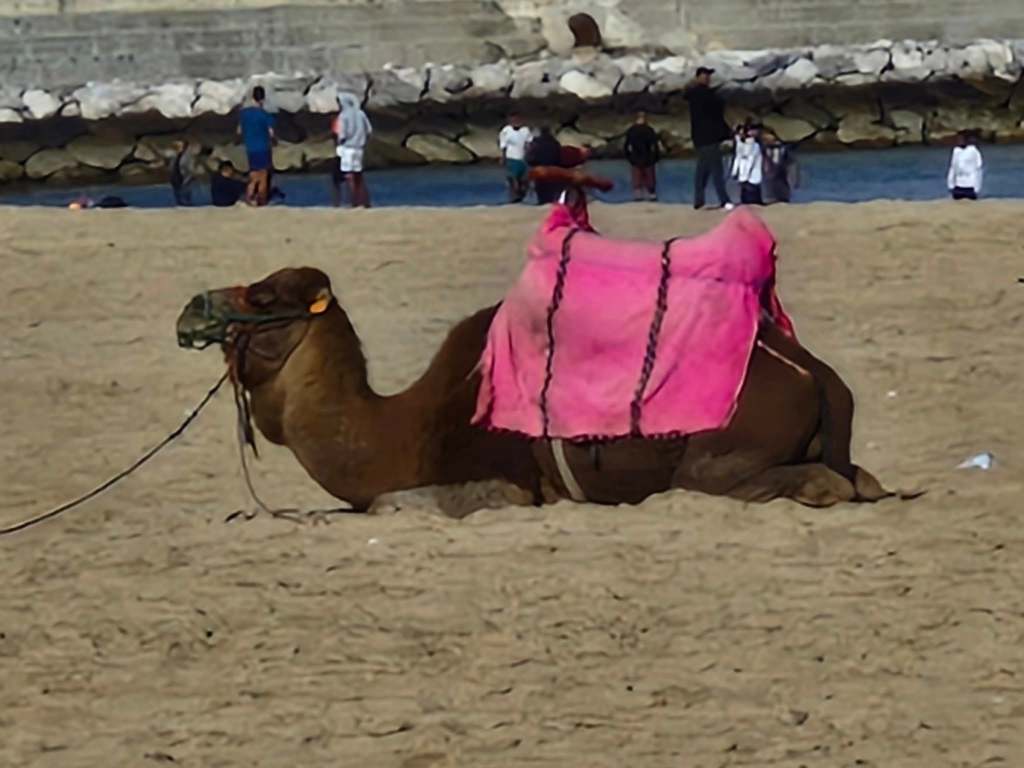
The following day gave us sunshine so after a quick outdoor coffee on a terrace in a medina café with indoor smoking and without tourists, we walked down to the coast (La Corniche) again for a breakfast looking at the sea. Based on my judgement (and Google Maps) the landmass in the distance must have been the southernmost tip of Spain. Tangier is located on the Tingitan peninsula and is on the coast where the Atlantic Ocean meets the Mediterranean Sea. We took a walk along the beach where we spied some camels in the distance giving rides to tourists for a cash payment. A friendly local dog approached us and sat with us for half an hour before heading on his way. I noticed that he had a yellow plastic earring. I wondered what that was. Lunch was consumed outdoors where I had a lamb shawarma – a dish traditional to the Middle East but seeing as Morocco is an Arab-Berber country the cuisine is similar. Moroccan cuisine is very tasty but not new to me. Having lived in Amsterdam – a city with a large Moroccan population- for many years I know my Moroccan dishes.
My plan to visit Madrid in December 2022 was thwarted, when standing at the gate in Dublin Airport, ready to board at 7pm an announcement was made, to inform us that due to weather conditions our flight was cancelled. Disappointed, as I had been looking forward to visiting the Spanish capital for the first time since 2006. This December another flight was booked – for our winter wanderings we’d be spending three days in Madrid followed by three days in Tangier in the northernmost tip of Morocco. Sunshine at this time of year is a great means of cheering oneself up in the Irish grey season.
‘Guernica’ by Picasso at the Reina Sofia Museum
The Ryanair flight from Dublin to Madrid was non-eventful and we landed at 2pm, whereby we each acquired a ten-ticket metro pass for fourteen euros and followed the internet’s instructions on how to access our apartment. Lunch, en route in Chinatown involved Szechuan chicken and rice. Out apartment was located on the edge of the city centre so theoretically it was possible to walk to the heart of the city. We took the metro that evening to Gran Via which was festooned in Christmas lights. We enjoyed a few drinks in the Chueca district which seemed to have calmed down from the riotous party district it had been twenty years ago. A more likely story is that Chueca has remained the same and it is I that has become more sedate. We dined on pizza at ‘ThatsAmore’ – a pizzeria owned and run by an Italian man. Rather tasty.




 midnightmurphy