This UNESCO world heritage site is is the largest archaeological park in Europe and the Mediterranean, and houses a wide range of ancient Greek temples. Sicily of course was part of the ancient Greek empire, long before the rise of the Roman empire. Having visited the Parthenon in Athens a few years earlier I was looking forward to the trip.
I rose at 6.45am and checked my email. The trip to the valley of the Temples was cancelled due to ‘extreme weather conditions’. This was quite the shock until I checked the forecast for the day – a balmy 36 degrees celsius. That would seem sensible. Climbing hills in such heat was probably unwise. Back to bed for another two hours in my air conditioned room.
After breakfast on a terrace at a local city centre cafe we wandered over to the church where I had booked a last minute, English ‘free’ walking tour of city centre Palermo (not really free because you are expected to leave a tip for the guide based on your enjoyment of the tour.)
Palermo is a city of 850,000 residents and is Italy’s fifth largest city (after Rome, Milan, Naples and Turin) so well suited to a tour. These walking tours are a great method of orientating yourself in a new city and offer you an interesting context for your own later wanderings. Our guide took us to see Teatro Massimo (the third largest opera house in Europe after Paris and Vienna and where scenes from ‘The Godfather III’ were filmed). We stopped at the Quattro Canti – the Baroque square considered the centre of the historic part of the city. This is the intersection of the Via Maqueda and the Corso Vittorio Emanuele and is very beautiful.
The Square of Shame contains the Fontana Pretoria – a fountain with sixteen nude statues of humans and mermaids. Built in the sixteenth century, its name derives from either the squandering of public money by the rulers of the city to pay for ornate Florentine marble while the poor people watched on hungrily; or the fact that the nude statues are located between a monastery and a convent, so the allegedly celibate monks and nuns had to witness this filth every time they ventured out. Rumours that the nuns and monks used to meet in the tunnels between the two grand buildings (now used as local government offices) is baseless, sleazy talk. Nuns and priests would never engage in shenanigans. Or so I have been told.

The cathedral of Palermo is a fabulously, ornate building from the outside, but rather plain within – for a Catholic church at least. The trip to the roof was unpleasant. So many steps in such unbearable heat was a struggle.
We had lunch at Capo market – a teeming, bustling place, thronged with people and food stalls. I dined on an unidentified fish and pasta dish.
After a siesta we dined al fresco on the busy restaurant street and enjoyed a super-expensive cocktail in a glamourous piano bar.
The following morning our NO-Mafia walking tour by Addio Pizzo was gathering at 11am. This group is a civil anti-Mafia group. The three hour tour explained the history of the Cosa Nostra in Sicily, how embedded it was in Sicilian society and how local residents, police and government decided to resist its pernicious influence. I was interested to hear how the Mafia wasn’t simply men in dark suits looking for brown envelopes full of protection money like you’d see in ‘Goodfellas’ or at a Fianna Fail Ard Fheis, but could be something as simple as a phone call to a bakery ‘encouraging’ him to buy flour from a certain miller; or a ‘suggestion’ to a local bar owner to install a slot machine. We heard about how certain businesses resisted (an orange sticker in the window shows that a business is officially anti-mafia). We learned how the mafia murdered judges and prosecutors who were pursuing them; and how the mafia is massively weakened in 2024 and has reverted underground. All while walking around the old city. We passed through Capo market where we had lunch the day earlier again – apparently this place used to (still has?) a mafia presence. This was an absolutely fascinating tour and I would highly recommend it.
After the tour we visited the Norman Palace and the Cappello Palatina. The Normans didn’t just invade Ireland. They also came to Sicily. The ridiculously elaborate Cappello Palatino as as gaudy and ornate, as all Mediterranean churches should be.

That evening we took a bus to the harbour where we drank an Aperol Spritz before going on a thwarted mission to find the night market. After an hour searching we headed back to town for dinner and finished the evening drinking beers in a friendly Sicilian heavy metal bar.
The next morning we checked out and took the bus to the eastern side of the island to the town of Catania where we had planned a two night trip. Arriving at 4pm we checked in to another maze like apartment and immediately headed out to see the cathedral and castle (must sees in every European city) and then on to the temporary Caravaggio exhibition. He is my favourite Renaissance painter – probably as much for his debauched life, and the fact that one of his paintings The Taking of Christ (1602) was discovered in August 1990, in the dining room of one of the houses of the Jesuit Fathers on Leeson Street, Dublin, when they were selling the contents of their home; as much as for his beautiful paintings. It didn’t disappoint.

Catania is Sicily’s second city and it operates at a more sedate pace. We dined on a terrace again beside a gay couple and a straight couple. For some reason the straight guy didn’t utter a single word all evening. I wanted to ask him why, but as this would reveal my eavesdropping nature, I kept quiet.
On Wednesday morning we met our guide at the pre-arranged place for our journey up the volcano. Mount Etna is the most active volcano in Europe and is due another eruption imminently. Catania is built in its foothills but seems to not to be in danger as lava flows would probably not reach it. It was fascinating to see how the landscape could vary mere metres apart – the stretches that had not been touched by lava in recent decades was fertile land. The higher we went the more stony and barren the land became. It takes many years for full vegetation to grow where a volcano has exploded. We’d been warned to dress for cold weather as we were at a high altitude. It was still about twenty five degrees however and climbing that mountain was strenuous. We also descended into a volcanic cave with a headlight showing us our way.
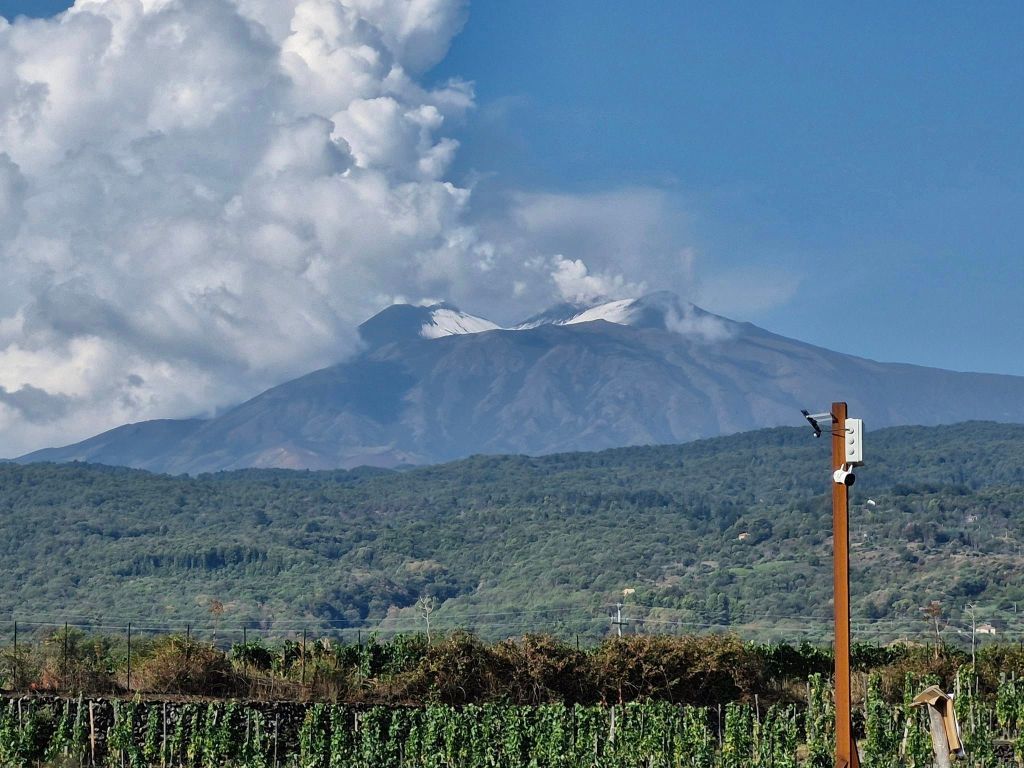
Our NO Mafia guide in Palermo had said that she didn’t like the way Sicily was best known for the mafia. Surely Mount Etna in its natural rage and splendour is a rival for that accolade.
After the volcano we drove on to the town of Taormina – the paradise town on the Mediterranean coast made famous in recent years as the setting for ‘The White Lotus’. It was magical town and the Greek amphitheatre was being set up for a concert later that evening. You’ve got to hand it to the Greeks – their designs have stood the test of time.
A Korean meal that evening and a beer on the terrace ended the day.
On Thursday we took the short bus journey south to the city of Siracusa – or more specifically to the island of Ortigia which was originally settled by the Greeks thousands of years earlier.
Lunch was an ordeal. My companion has an intolerance towards gluten. While not nearly as serious as a coeliac condition nonetheless it’s wiser for him to avoid certain foods. I am sure he doesn’t find it nearly as amusing as I do, when I call him a ‘flour dodger’. What I had noticed in both Palermo and Catania that when accosted by the table touts trying to lure you into their dining establishments if you ask ‘Pasta, pizza senza glutine?’ they will invariably reply ‘Si’ only to approach you when you are seated to tell you that actually no, this option is not available.
In Ortigia, the woman told us that of course they had gluten free pasta. The sullen waiter took our orders and brought us our lunchtime Aperol Spritz. The wait began. After forty minutes we asked the table tout where our food was. She told us it was coming. After ten minutes we asked the surly waiter. He told us it was coming. Countless tables which had been seated after were tucking into or finishing their food. Another ten minutes went by. We left the money for our drinks on the table and stood up. The waiter chased us. Angrily he tried to convince us that it was our fault as they had no gluten free pasta and had to go out to buy it. Tell the table tout to stop lying then, we replied, and made a run for it.
Our apartment in Ortigia was more compact but perfectly pleasant. We took a stroll around – taking in the cathedral, the castle on the seafront and the ancient Greek temple. We crossed the bridge to the mainland of Siracusa for an Indian that evening. We could guarantee a gluten free meal there, then back for a glass of wine on the island watching the dappled lights on the seawater.
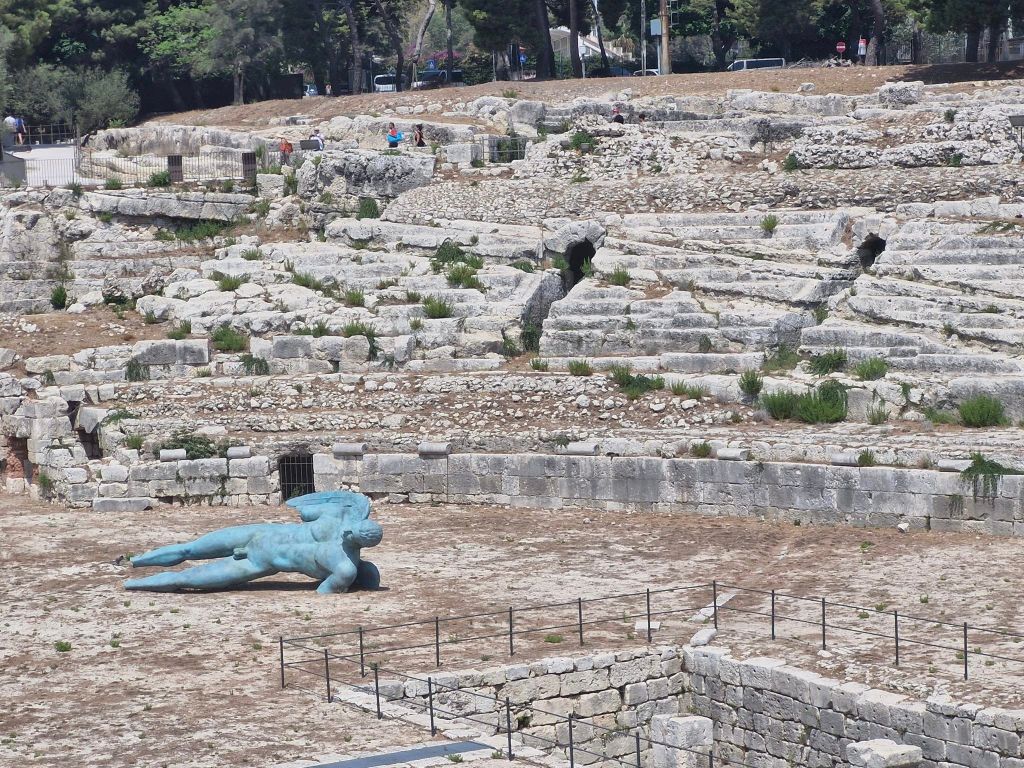
The next day was our last full day on the island. We went to the Archaeological Park on the mainland where in the sweltering heat we saw the Greek Amphitheatre and the Roman Amphitheatre and various other ancient wonders. We had drinks that evening in the bar on the ground floor of our building.
The following morning we bid farewell to Ortigia and each other. My friend was travelling back to London from Catania whereas I was making my way back to Palermo.
A marvellous holiday.
Note to self in future – Sicily is an incredible place but maybe April or October is a milder time to visit.
 midnightmurphy